EN
EN

What are you looking for?

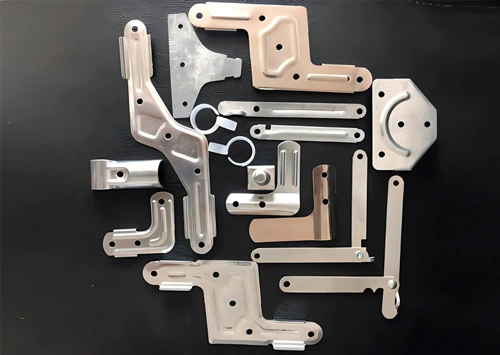
EV powertrains depend on reliable, low-resistance electrical pathways — especially inside battery packs where current is high and thermal margins are tight. Precision metal stampers have become a critical part of the EV supply chain: stamped battery connectors and busbars must meet strict requirements for flatness, burr control, plating quality, and repeatability at scale. This guide explains what to look for when sourcing metal stamping China partners for EV-grade components.
.png "Metal Stampers: The Role of Precision Stamping in the EV Battery Revolution")
EV battery packs operate at current levels and power densities that magnify the consequences of poor stamping quality. A busbar with a 10% higher contact resistance than specified does not just reduce efficiency — it creates a localized heat source inside a sealed battery pack where thermal management is already engineered to tight margins.
| EV-Specific Demand | Quality Consequence of Poor Stamping | Risk Category |
|---|---|---|
| High continuous current (50–400A per cell string) | Contact resistance hotspots from poor surface contact or dimensional drift | Thermal runaway risk; warranty claim |
| Tight cell-to-cell spacing | Burrs from stamping can damage cell insulation or create short-circuit paths | Safety-critical |
| Laser or ultrasonic welding joins | Poor flatness or surface contamination prevents reliable weld formation | Structural joint failure |
| High cycle vibration from road loads | Dimensional inconsistency causes fretting at connections over time | Intermittent fault; hard-to-diagnose |
| 10-15 year pack life expectation | Plating degradation and corrosion at contact surfaces increases resistance over time | Long-term reliability |
EV battery component requirements are increasingly aligned with automotive IATF 16949 quality standards — not general industrial manufacturing standards. Metal stamping China suppliers serving the EV market need tooling discipline, in-process controls, and documentation practices that reflect the safety-critical nature of the application.
| Material | Conductivity | Weight | Cost | Best Application |
|---|---|---|---|---|
| Pure copper (C11000) | Highest — 100% IACS | Heavy | High | Maximum conductivity; high-current inter-cell connections |
| Copper alloy (C19400, C26000) | 85–95% IACS | Heavy | Moderate to high | Balance of conductivity and spring/formability for connector applications |
| Aluminum (1100, 3003 series) | ~60% IACS | Light — 3x lighter than copper | Lower | Weight-sensitive applications; module-to-module connections |
| Nickel-plated copper | Same as copper base | Same as copper | Copper + plating | Where corrosion resistance at the contact surface is required |
Thickness: EV busbars are typically 0.5–4 mm depending on current rating — thicker material requires higher tonnage tooling and more attention to springback control
Bend radii: minimum bend radius is typically 1–2× material thickness for copper; tighter bends require stress relief or special tooling
Springback control: copper alloys and aluminum both spring back after bending — tool compensation or post-bending sizing operations are required for tight angular tolerances
Joining zones: the areas where busbars connect to cells or module terminals must be flat, burr-free, and dimensionally consistent to support reliable laser welding or mechanical fastening
| CTQ Characteristic | Why It Matters | Typical Specification |
|---|---|---|
| Burr height | Burrs can penetrate cell pouch insulation or create shorts at assembly | Less than 0.05–0.10 mm on critical edges |
| Flatness | Required for consistent laser weld contact and cell terminal interface | Less than 0.1–0.2 mm over the weld zone footprint |
| Hole position tolerance | Cell terminal bolts and alignment pins must engage reliably | ±0.1–0.2 mm on critical features |
| Edge condition | Rolled edge vs. clean shear — affects contact area and weld penetration | Defined by the downstream joining process |
| Thickness consistency | Current carrying capacity and resistance are proportional to cross-section | ±0.02–0.05 mm typical for precision applications |
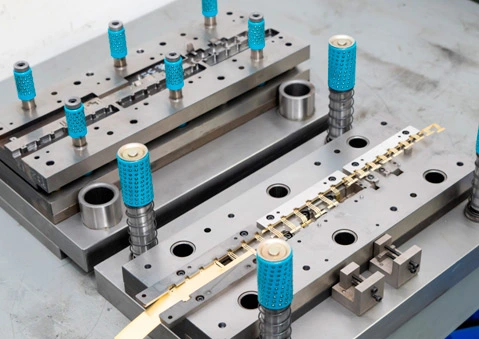
Progressive die construction: multi-station progressive dies maintain feature-to-feature relationship better than separate tooling operations — critical for maintaining hole pattern relative to bend zones
Fine blanking: for applications requiring very low burr height and tight edge quality — particularly around weld zones and contact pads
Die maintenance schedule: burr height increases predictably as punch and die clearance opens with wear — a defined maintenance interval based on shot count is required, not calendar-based
In-line vision inspection: automated optical checks on burr, edge condition, and feature presence after stamping — before plating or secondary operations
A metal stamping China supplier qualified for EV hardware should provide:
First article inspection report with all CTQ dimensions measured against drawing
Process capability (Cpk) data for critical dimensions confirming the process is stable
Burr measurement method documentation — how is burr height measured and what equipment is used?
Tool maintenance log showing punch/die replacement history
The surface of a stamped busbar or connector is where the electrical contact actually occurs. Bare copper oxidizes — and copper oxide is a poor conductor. The plating choice determines how stable the contact resistance remains over the product's service life.
| Plating Type | Contact Resistance | Oxidation Resistance | Temperature Range | EV Application |
|---|---|---|---|---|
| Tin (electroplated) | Good — low contact force needed | Good in moderate humidity | Up to 150°C | General cell interconnects; cost-effective |
| Nickel | Higher initial resistance; very stable | Excellent | Up to 250°C | High-temperature zones; under-hood adjacent applications |
| Silver | Lowest contact resistance | Good in most environments | Up to 200°C | High-performance contacts; low contact force applications |
| Gold flash over nickel | Excellent and stable | Excellent | Up to 150°C | High-reliability sensing and low-current signal contacts |
Plating thickness variation is the most common source of plating-related field failures:
Minimum and maximum thickness must both be specified — too thin and the plating wears through; too thick and adhesion can be compromised by internal stress in the plating layer
Adhesion testing: cross-cut or tape test, or bending test after plating to confirm the plating follows the substrate without cracking or delamination
Porosity testing: particularly for noble metal platings over copper — pores in the plating allow the copper substrate to oxidize and bleed through
For EV-grade components, the stamping and finishing process must be treated as a single controlled flow:
Stamping → deburring (if required) → cleaning → plating → inspection → packaging
Any break in this flow that allows oxidation, contamination, or mechanical damage to occur between stages compromises the plating adhesion and contact surface quality
Cleanliness controls between stamping and plating are as important as the plating process itself — oil, stamp lubricant, and fingerprints all affect plating adhesion
| Question | What a Qualified Supplier Can Answer | Red Flag |
|---|---|---|
| What is the designed die life for our part? | Number of shots between maintenance intervals; number before replacement | "We'll maintain as needed" without a data-backed answer |
| How do you control springback? | Specific tooling compensation approach for the material and thickness | No specific answer for your material |
| What is your finest blanking capability? | Minimum burr height achievable for the edge requirements | Cannot achieve the specified CTQ |
| How do you verify tool wear before it affects quality? | In-process measurement schedule correlated to shot count | Calendar-based only; no measurement data |
EV OEM and Tier 1 customers typically require documentation aligned with IATF 16949 or equivalent:
Control plan: documents every process step, what is controlled, how it is measured, and the reaction plan for out-of-spec conditions
FMEA: identifies failure modes and confirms they are addressed in the process design
Material traceability: incoming material certificates, heat number linkage to finished parts
Change control (PCN process): supplier cannot change material, tooling, or process without formal notification and customer approval
Prototype samples: first stamped samples for design validation — confirm fit, form, and plating before committing production tooling
Pilot run (typically 300–1,000 pieces): confirms process stability and generates capability data
Capability studies: Cpk measurement on all CTQ dimensions — minimum Cpk 1.33 for approval
Mass production release: formal customer approval against PPAP or equivalent documentation package
EV batteries scale on precision. The right metal stampers deliver busbars and connectors with repeatable geometry, controlled burrs, and stable plating — reducing hotspot risk and improving pack reliability across millions of production cycles. When evaluating metal stamping China suppliers, prioritize CTQ control, tooling discipline, and automotive-style documentation so your components remain consistent from prototype through volume production.
Q1: Why are precision metal stampers critical for EV battery connectors and busbars?
EV battery components carry high continuous current in tightly packaged assemblies with limited thermal margin. Any increase in contact resistance from burrs, poor flatness, or plating defects creates localized heat that accelerates insulation degradation and in extreme cases contributes to thermal events. Precision stamping ensures consistent contact area, repeatable geometry for joining processes, and reliable plating adhesion over the battery's 10–15 year service life.
Q2: What stamping quality issues cause problems in EV battery assemblies?
Excessive burr height on cell-adjacent edges can damage pouch cell insulation and create short-circuit paths. Poor flatness prevents reliable laser weld contact between the busbar and cell terminal. Dimensional drift in hole positions causes assembly interference and inconsistent joint quality. Plating defects — thin spots, adhesion failures, porosity — cause contact resistance to increase over time as the base metal oxidizes.
Q3: What should I verify with a metal stamping China supplier before starting production?
Verify their tooling design capability and die life strategy for your specific material and thickness. Confirm their CTQ inspection methods and what evidence they can provide for burr measurement and flatness verification. Ask specifically about their change control process — how they notify customers of any material, tooling, or process change. Request Cpk data from previous similar parts as evidence of process capability.
Q4: Can stamped busbars be reliably laser welded or ultrasonically welded?
Yes, when the joining zone is designed correctly. The weld zone must be flat within the welding process tolerance (typically less than 0.1–0.2 mm), burr-free, and have compatible plating. Silver and tin platings are generally compatible with laser welding; nickel can be welded but may require adjusted parameters. Suppliers should provide sample welds for destructive testing before production tooling is approved.
Q5: What information is required for an accurate metal stamping quotation?
Provide 2D drawings and 3D CAD files with all CTQ tolerances and GD&T callouts, material specification and thickness, plating type and thickness requirements, annual production volume, any required joining methods and their surface preparation requirements, and documentation requirements such as PPAP level or equivalent for your customer's supply chain qualification process.